
Geography and the Need for Sea Crossings
Scotland's western seaboard is one of the most indented coastlines in Europe. Glaciers carved deep valleys that the sea later flooded, leaving long fjord-like sea lochs such as Loch Fyne, Loch Linnhe and Loch Sunart. Between and beyond them lie the islands of the Inner and Outer Hebrides and the Firth of Clyde. Land routes are long, steep and winding, while sea routes are often short and direct.
This geography explains why so much of western Scotland's history is maritime. For island communities there was no alternative to the boat, and even on the mainland it was frequently quicker to sail across a loch than to travel around it. Scottish ferry history is therefore not a side story to the history of the Highlands — it is central to it.
Early Coastal Communities
Archaeological sites from the Neolithic onwards show that people settled the islands and coasts of the west from very early times, moving between them by sea. Settlement favoured sheltered bays, raised beaches and fertile machair, where boats could be drawn up and both land and sea worked. In the medieval period, Norse rulers and later the Lordship of the Isles governed a sea-based realm whose power depended on galleys and on control of the sounds and narrows.
Clan territories frequently spanned both sides of a stretch of water. The narrow crossings — the kyles, sounds and caols — became natural meeting points, landing places and, in time, recognised ferry points.
Traditional Boats and Early Crossings
Before steam, west coast boats were open wooden craft powered by oar and sail. Local ferrymen worked many short crossings, often holding the right to do so from a landowner and sometimes keeping an inn beside the landing. Services depended on weather, tide and daylight.
One of the most important traffics was livestock. Black cattle from the islands were driven to the great trysts at Crieff and later Falkirk, and at narrow crossings animals were sometimes made to swim. The Gaelic name of Colintraive, commonly interpreted as "the strait of the swimming", is a reminder of this practice on the Kyles of Bute.
Maritime Trade in Western Scotland
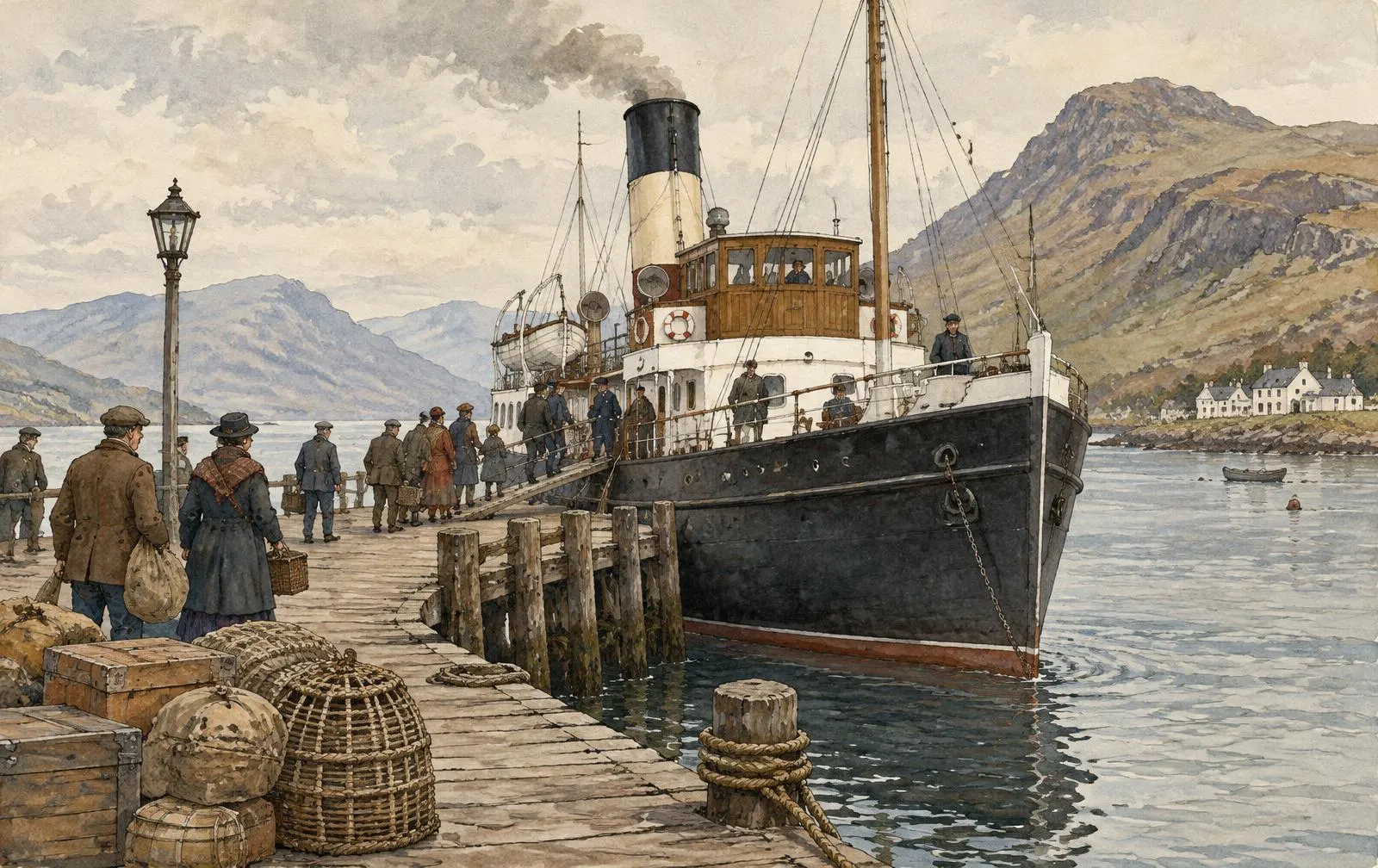
The islands exported cattle, fish, wool and, in the late eighteenth and early nineteenth centuries, kelp — seaweed ash used in glass and soap making. In return came meal, salt, tools, timber, coal and manufactured goods from Glasgow and the Clyde ports. Sailing smacks, puffers and coasters served piers and beaches, and the Crinan Canal (opened 1801) and Caledonian Canal (opened 1822) shortened routes between the Clyde, the Hebrides and the east coast.
The Arrival of Steamships
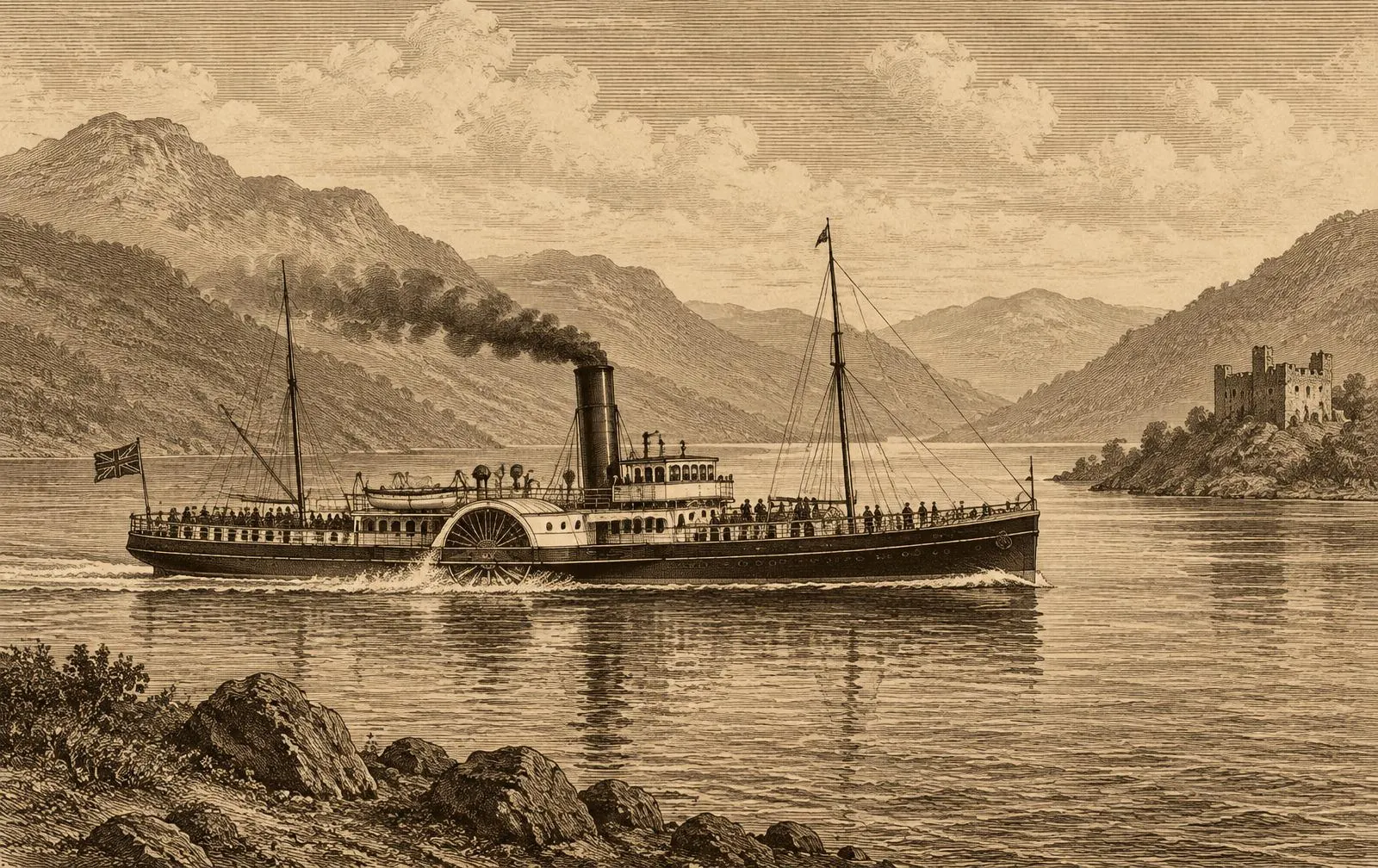
In 1812 Henry Bell's paddle steamer Comet began carrying passengers between Glasgow, Greenock and Helensburgh — the first commercial steamboat service in Europe. Within a few years steamers were sailing to the West Highlands, and by the mid-nineteenth century regular routes linked Glasgow with Oban, Mull, Skye and the Outer Hebrides.
Steam freed ships from dependence on the wind. Sailings could be timetabled, mail carried reliably, and journeys of days made in hours. On the Firth of Clyde, competing railway and private steamer companies built a dense network of piers serving resorts such as Rothesay, Dunoon and Largs.
The Development of Regular Ferry Services
In 1851 David Hutcheson & Co. was formed to take over the West Highland steamers of G. & J. Burns, with David MacBrayne as a partner. After the Hutcheson brothers retired, MacBrayne became sole owner and from 1879 the business traded under his own name. MacBrayne's red-funnelled steamers became a familiar sight across the Highlands and Islands.
On the Clyde, the Caledonian Railway established the Caledonian Steam Packet Company in 1889 to run steamers connecting with its trains. Through the twentieth century, mergers and state involvement gradually brought operators together.
The History of Caledonian MacBrayne
In 1928 the company was reconstituted as David MacBrayne (1928) Ltd, jointly owned by the London, Midland & Scottish Railway and Coast Lines. When the railways were nationalised in 1948, the railway share passed into state ownership. The Transport Act 1968 created the Scottish Transport Group, which from 1969 owned both the Caledonian Steam Packet Company and MacBrayne's shipping services.
On 1 January 1973 the two fleets were combined as Caledonian MacBrayne, commonly known as CalMac. In 2006, to meet European rules on public service contracts, the business was restructured: ferry operations passed to CalMac Ferries Ltd, while vessels, harbours and infrastructure became the responsibility of Caledonian Maritime Assets Ltd (CMAL). Both remain publicly owned.
This website is independent and has no connection with CalMac Ferries Ltd, David MacBrayne Ltd or CMAL. The summary above draws on widely published sources and is provided for educational purposes.
The Introduction of Automobile Ferries
Early motorists wishing to reach an island had their cars lifted aboard by crane or carried on small open boats. As car ownership grew after the Second World War, purpose-built vehicle ferries appeared. In 1964 Hebrides, Clansman and Columba entered West Highland service, loading cars by hoist and side ramps. Through the late 1960s and 1970s, drive-through "roll-on, roll-off" vessels became standard, along with small ramped ferries for short crossings.
Ferry Terminals and Slipways
Vehicle ferries required new infrastructure. Piers designed for steamers were often unsuitable, so concrete slipways were built at many short-crossing points, allowing a ferry to lower its ramp onto the shore at any state of the tide. Larger terminals gained linkspans — adjustable bridges between quay and ship — with marshalling lanes, waiting rooms and ticket offices. Read more on our car ferries and timetables page.
Modern Island Transportation
Today the CalMac network serves around fifty destinations on the west coast. Ferries carry residents to work, school and hospital appointments, supply island shops and businesses, and bring the visitors on whom much of the island economy depends. Fares on many routes are set using Road Equivalent Tariff, piloted from 2008 and later extended across the network, which links the price of a crossing to the cost of driving an equivalent distance. Vessel age, reliability and replacement remain major issues in Scottish public life.
Historical Timeline
- 1801
Crinan Canal opens
A short cut between Loch Fyne and the Sound of Jura avoids the passage around the Mull of Kintyre.
- 1812
PS Comet
Europe's first commercial steamboat service begins on the Clyde.
- 1822
Caledonian Canal opens
Links the west coast with Inverness and the Moray Firth.
- 1851
David Hutcheson & Co.
Takes over West Highland steamer services, with David MacBrayne as partner.
- 1879
David MacBrayne
MacBrayne becomes sole proprietor.
- 1889
Caledonian Steam Packet Co.
Founded by the Caledonian Railway for Clyde services.
- 1928
David MacBrayne (1928) Ltd
Jointly owned by the LMS Railway and Coast Lines.
- 1964
Car ferries arrive
Hebrides, Clansman and Columba enter service.
- 1969
Scottish Transport Group
Takes ownership of both the CSP and MacBrayne fleets.
- 1973
Caledonian MacBrayne
The combined operator begins trading on 1 January.
- 2006
CalMac Ferries Ltd & CMAL
Operations and asset ownership are separated.
- 2008
Road Equivalent Tariff
Piloted on Western Isles routes, later extended across the network.